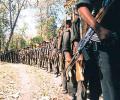
'There is simply no evidence of any new or clear policy direction in internal security, and mounting evidence of policy incoherence.' 'Worse, the promise of giving the common man -- and, more importantly, woman -- a greater sense of security has been utterly belied. Indeed, with an escalation of communal posturing and rhetoric, there is a broader sense of uncertainty,' says Ajai Sahni.

"Crores of Muslim women had always demanded that triple talaq should be banned, as it is also banned in Islamic countries," he said.

The government's leaks to the media and General Singh's very vocal comments on the charges against him have played right into the hands of separatists and their cross-border sponsors, says Nitin Pai

To redevelop cities as 'smart', investment of at least $10 billion is required. For 100 cities, it works out to $1 trillion

Team Menstrupedia is inspiring young girls to break taboos and speak about their problems related to menstruation and instilling confidence in them.

Most experts said indices would open higher on Monday and rally might sustain for a few sessions

Om Puri was that rare actor who could carry a film on sheer power and versatility of his performance

Putting together a play about the Father of the Nation is no easy task. But when that play is a musical, the challenges increase.
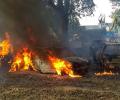
'There is no remorse over the Dadri lynching of Mohammad Akhlaq or of Pehlu Khan by cow vigilante groups.' 'But should you not have remorse for those who came to kill them?' 'They were Hindus. Do you accept that?' 'That to kill one Pehlu, 20 Hindus have become murderers.' Rajdeep Sardesai in conversation with Ravish Kumar.

Vandana has been attempting to bring in radical changes in the unhealthy food habits amongst the tribals.

'Who in Pakistan was intending to carry out one of the most grievous acts of international terrorism just a few months ago?' Former CIA official Bruce Riedel reveals how the Lashkar-e-Tayiba and the ISI planned the attack on the Indian consulate in the Afghan city of Herat in May to take Indian diplomats hostage and disrupt Narendra Modi's swearing-in.
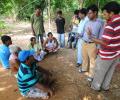
Abhishek Singhania left a career at PwC to work in a food security project as a research fellow.

In an interview with Shobha Warrier/Rediff.com, he talks about the economic policies of the Narendra Modi government and whether achche din is really coming.

Leading think tank discusses a likely Narendra Modi government and America's engagement with the man US once scorned. Aziz Haniffa reports
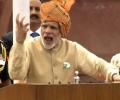
As Prime Minister Narendra Modi is set to deliver his third Independence Day speech on August 15, he is inviting ideas from citizens on issues he should speak on

'What we need is right skilling, re-skilling and up-skilling.'

'It is very hard to get the police to file a report against someone from an upper caste.' 'Things are so bad that sometimes we have to sit on a dharna with the body of a Dalit victim to get the police to file a complaint.'
'When Hindus converted through inducements there was no hue and cry, but when reconversions took place, everyone cried foul. If re-conversions are bad, so are conversions.' 'Our government is not getting involved either in conversions or re-conversions. The BJP has nothing to do with it.' Parliamentary Affairs Minister M Venkaiah Naidu in a candid interview.

Winners of the Stree Shakti Puruskars share their stories on how they are empowering women. Upasna Pandey/Rediff.com reports

'The only positive I see are the youth of India who were earlier just after money. The young now want to do something for society.'

What is Change really like in Bihar? Once seen as India's basket-case, what is its turnaround story like?

On the occasion of the first prime minister Jawaharlal Nehru's 125th birth anniversary, Sheela Bhatt/Rediff.com visits his residence of 16 years, and comes away marvelling at his enduring legacy.

'Indian politics has had three-and-a-half master narratives -- secular nationalism, Hindu nationalism, justice for lower castes and regionalism. The AAP seeks to go beyond that. Therein lies its promise and its challenge,' says Ashutosh Varshney, Brown University professor and author of book Battles Half Won, India's Improbable Democracy.

'Since Modi is walking a tightrope between two worlds -- one of the saffron brotherhood and the other of the proposed smart cities and bullet trains -- it is understandable why he is averse to scrutiny lest he loses his balance by tilting too heavily on one side or the other. But, why has Sonia Gandhi acquired the reputation of a sphinx,' asks Amulya Ganguli.

Forty years after the declaration of Emergency by Indira Gandhi, the Sunanda K Datta-Ray recalls life when civil rights were suspended and press censorship was in force
For the first time in our economic history a government has thought about more than 50 per cent of our economic activity instead of the five per cent represented by the Sensex companies, observes IIM-B professor R Vaidyanathan.

Our large military requirements make for an enormous buyer's leverage, which the defence ministry fritters away in piecemeal purchases

Over Lebanese delicacies, the daughter of billionaire Kumar Mangalam Birla talks money, relationships, her passions and how she outpaced her peers.

The government has provided a long-term vision.

Even as plans to redevelop Dharavi continue to gather dust in government files, its young residents have chalked their own course and chosen to fly high. Hepzi Anthony recounts a few inspiring tales.
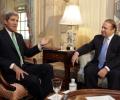
Pakistan Prime Minister Nawaz Sharif continues his exhortation for US mediation in Kashmir, and harks back to his meeting with former Prime Minister Atal Bihari Vajpayee when the latter had agreed to a resolution of Kashmir imbroglio; senior us officials assert there is 'absolutely no change in us policy' that Kashmir has to be resolved bilaterally. Aziz Haniffa reports.

'I was a very late child of my father. I was suddenly a little toy, who appeared from nowhere. Everybody experimented.' 'I don't know why I took up dancing. I think I wanted to find one more excuse to drop out from school.' Kamal Haasan gives us beautiful nuggets from his life.

'This has to be seen in the context not only of the legacy we inherited, but also of global economic weakness.'
'If after inheriting the very bad situation we have reached this level despite consecutive years of drought and no growth in the world economy, it is no accident.' 'It is a result of the sound macro economic policies followed by this government.' 'We have eschewed populism and stuck to a path of fiscal prudence.'
It is as much about farmer woes and the lack of job opportunities as about the mixing of religion and politics.

Prime Minister Manmohan Singh on Friday disagreed with those in the Congress who were dismissive of the challenge posed by Narendra Modi but asserted that the party would approach the 2014 Lok Sabha polls with self-confidence, irrespective of the results of the just concluded elections in five states.

The Indian Spring represented by Anna Hazare's anti-corruption campaign, which has culminated in the Aam Aadmi Party's impressive electoral debut in New Delhi, began around the same time as the Arab Spring in 2011 but they led to different outcomes in India and the Arab world, says Ramesh Ramachandran.

'Modi's investment in the relationship with Washington is the biggest deliverable of this visit. He means business and that's fantastic!'

Darjeeling is on the boil over the demand for a separate Gorkhaland state. June and July are bad months to have a strike. Tea picking during its most valuable season has been affected. Those consequences will be felt all over the world and ultimately damage Darjeeling tea.

What is Change really like in Bihar? Once seen as India's basket-case, what is its turnaround story like? Archana Masih reports from India's other most talked about state.

Prime Minister Narendra Modi, who recently completed one year in office, has, in an exclusive interview with Smita Prakash, editor, ANI, said the opposition alleging that his government is a "suit boot ki sarkar" is definitely better and more acceptable than being labelled a "suitcase" (ki sarkar), and satirically added, that after ruling for sixty years, the Congress has suddenly remembered the poor.
